- MPN / P/N
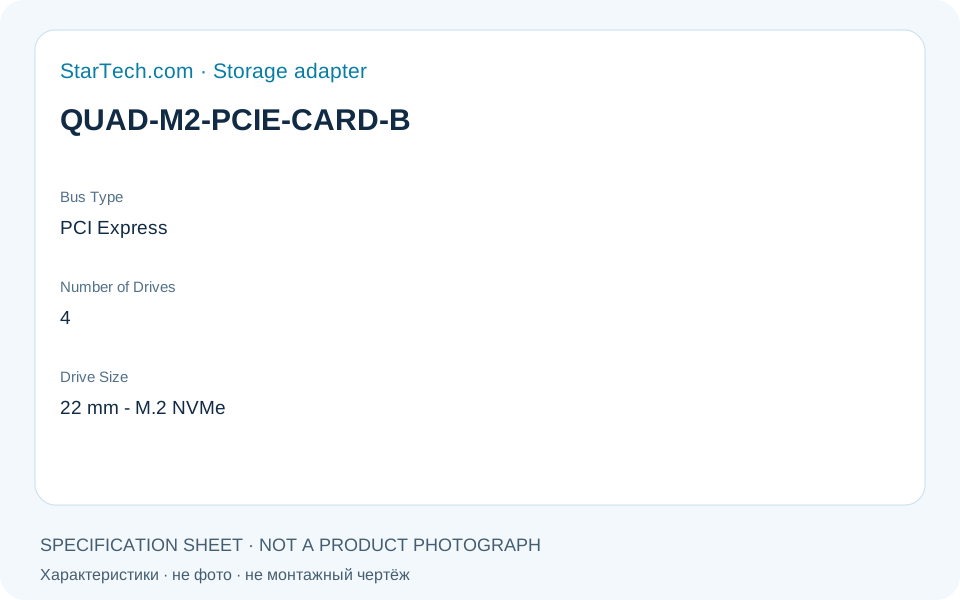
- QUAD-M2-PCIE-CARD-B
- Manufacturer designation
- Quad M.2 PCIe Adapter Card, PCIe x16 to Quad NVMe or AHCI M.2 SSDs, PCI Express 4.0, 7.8GBps/Drive, Bifurcation Required, Windows/Linux Compatible - TAA
- Manufacturer conditions
- NVMe SSDs require drivers provided by the manufacture of the; drive or may be natively provided by the OS (Windows 8 and; later). Earlier OS versions do not feature native NVMe support.; Consult the documentation that came with the; Computer/Motherboard for details regarding how to enable and; configure PCIe Bifurcation.
- System and cable requirements
- For multiple drives to be detected by the host system, bifurcation; support is required on the computer/motherboard.
- Colour
- Red
- Product length
- 5.0 in [12.8 cm]
- Product width
- 11.4 in [29.0 cm]
- Product height
- 0.9 in [23.0 mm]
- Product weight
- 4.5 oz [128.0 g]
- Operating temperature
- -40C to 80C (-40F to 176F)
- Storage temperature
- -40C to 85C (-40F to 185F)
- Humidity
- 15 ~ 90% RH
- Drive interface — source field designation
- PCI Express 4.0 (16 Gbps per lane)
- RAID
- No
- Hot-swap capability — manufacturer conditions
- No
- MTBF — not warranty duration
- 4,353,192 hrs
- Interface
- M.2 PCIe
- Bus type
- PCI Express
- Number of drives
- 4
- Drive size
- 22 mm - M.2 NVMe
- Compatible drive types
- M.2 (PCIe, NVMe, M-Key, NGFF)
- Drive installation
- Fixed
- Supported drive dimensions — source designation
- 2242; 2260; 2280; 22110
- LED Indicators
- 4 - Header pins, for drive activity
- Host Connector 1 (Quantity)
- 1
- Host Connector 1
- PCI Express x16
- Connector 1 (Quantity)
- 4
- Connector 1
- M.2 M-Key (PCIe, AHCI / NVMe)
- Documented selection limits
- Match the exact host interface, peripheral/device protocol, connector, firmware, OS/driver and power requirements before ordering. Published maximum rates are interface limits, not guaranteed application throughput. No universal device or current/future OS compatibility is implied. Match SATA versus PCIe/NVMe, M.2 key/length, PCIe generation/lane width and required bifurcation. A passive adapter cannot add a missing host protocol. Multi-drive/RAID and bootability require the explicitly stated host/firmware support; storage drives are not automatically included.

 Specification schematic, not a product photograph or installation drawing.
 Specification schematic, not a product photograph or installation drawing.
 Specification schematic, not a product photograph or installation drawing.
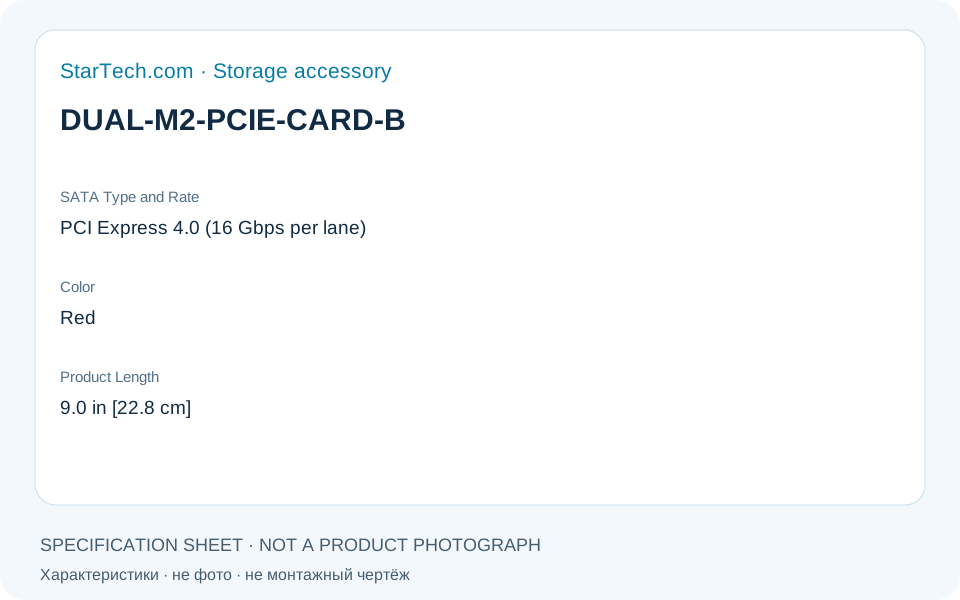 Specification schematic, not a product photograph or installation drawing.