- MPN / P/N
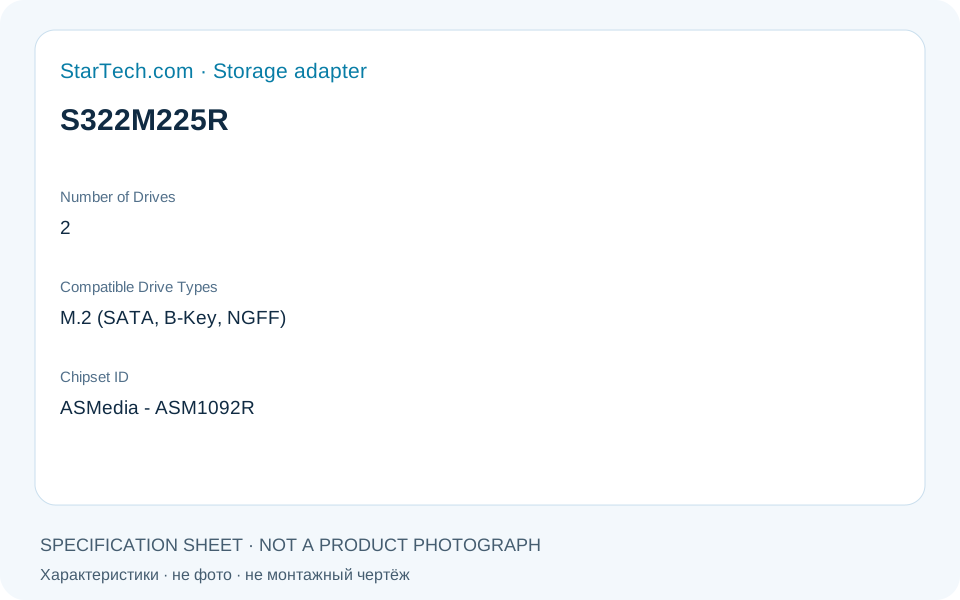
- S322M225R
- Manufacturer designation
- M.2 to SATA Adapter for M.2 SATA SSDs, Dual Slot M2 Drive Host Adapter/Converter with RAID Support, 2.5-Inch Drive Form Factor, TAA
- Manufacturer conditions
- TRIM and SMART have limited support while in a RAID; configuration. A SATA controller with Port Multiplier support is; required, in addition to the product configured in JBOD mode, to; provide full TRIM and SMART support.
- Input voltage
- 5V DC / 12V DC
- Output voltage
- 5 DC
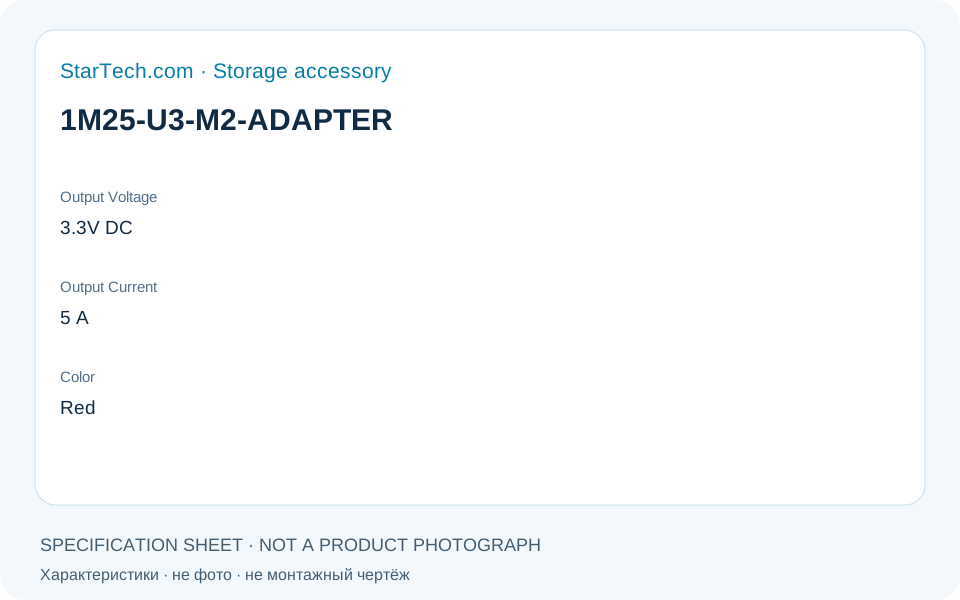
- Colour
- Red
- Material
- Steel
- Product length
- 3.9 in [99.8 mm]
- Product width
- 2.7 in [67.8 mm]
- Product height
- 0.3 in [6.5 mm]
- Product weight
- 1.4 oz [41 g]
- Operating temperature
- +5C to +50C (+41F to +122F)
- Storage temperature
- -25C to +70C (-13F to +158F)
- Humidity
- 15% to 90%
- Maximum documented data rate
- 6 Gbps
- TRIM Support
- Yes
- S.M.A.R.T. Support
- Yes
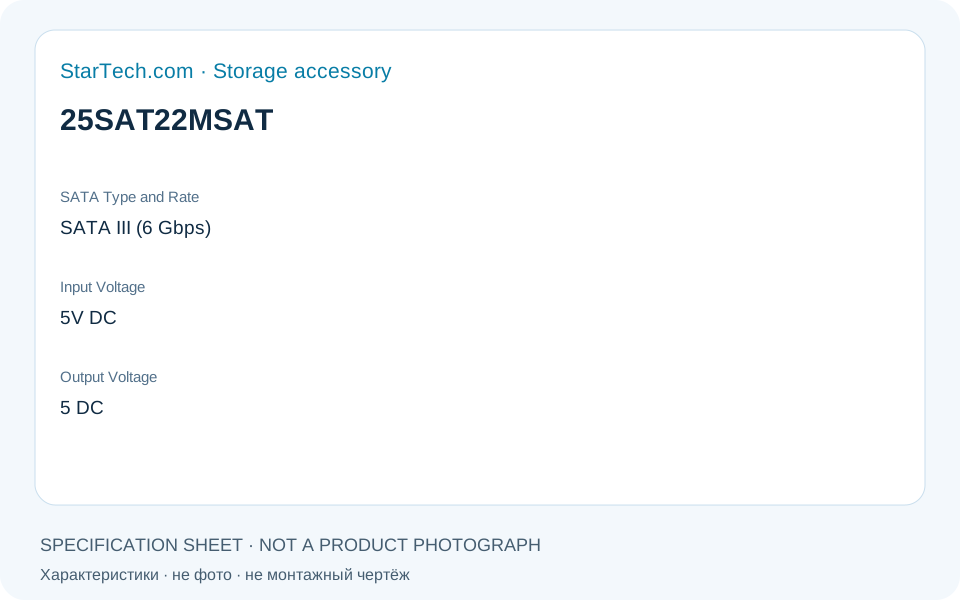
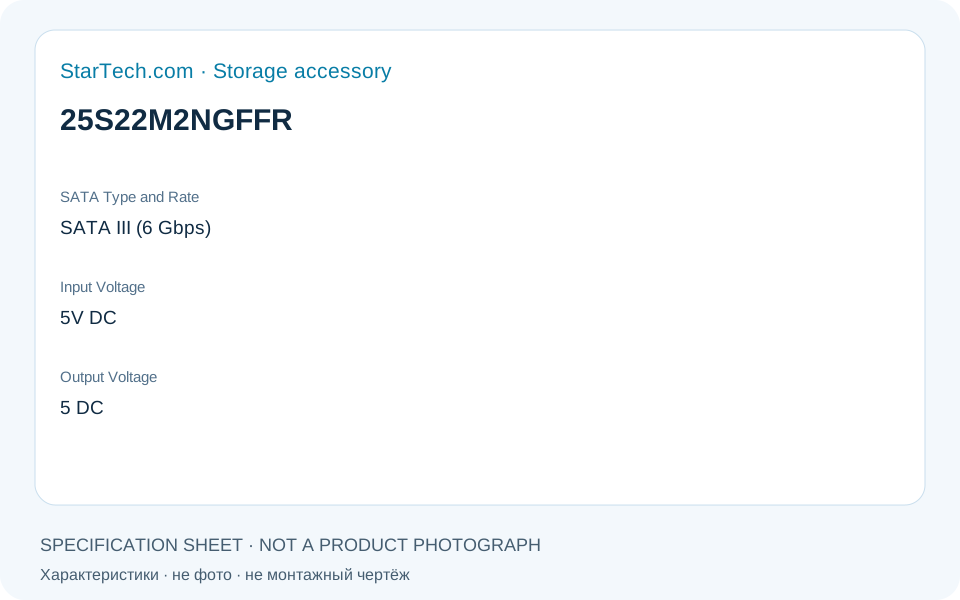
- Drive interface — source field designation
- SATA III (6 Gbps)
- Port Multiplier
- Yes
- RAID
- Yes
- Hot-swap capability — manufacturer conditions
- No
- General Specifications
- Not compatible with M.2 NVMe or AHCI PCI-Express SSDs; In order to see multiple drives in JBOD mode, your computer’s; SATA controller must also support Port Multiplier.
- Interface
- SATA
- Number of drives
- 2
- Compatible drive types
- M.2 (SATA, B-Key, NGFF)
- Drive installation
- Fixed
- Supported drive dimensions — source designation
- 2230; 2242; 2260; 2280
- Chipset ID
- ASMedia - ASM1092R
- Host Connector 1 (Quantity)
- 1
- Host Connector 1
- SATA (7-Pin + 15-Pin)
- Connector 1 (Quantity)
- 2
- Connector 1
- M.2 B-Key (SATA, AHCI)
- Documented selection limits
- Match the exact host interface, peripheral/device protocol, connector, firmware, OS/driver and power requirements before ordering. Published maximum rates are interface limits, not guaranteed application throughput. No universal device or current/future OS compatibility is implied. Match SATA versus PCIe/NVMe, M.2 key/length, PCIe generation/lane width and required bifurcation. A passive adapter cannot add a missing host protocol. Multi-drive/RAID and bootability require the explicitly stated host/firmware support; storage drives are not automatically included.

 Specification schematic, not a product photograph or installation drawing.
 Specification schematic, not a product photograph or installation drawing.
 Specification schematic, not a product photograph or installation drawing.
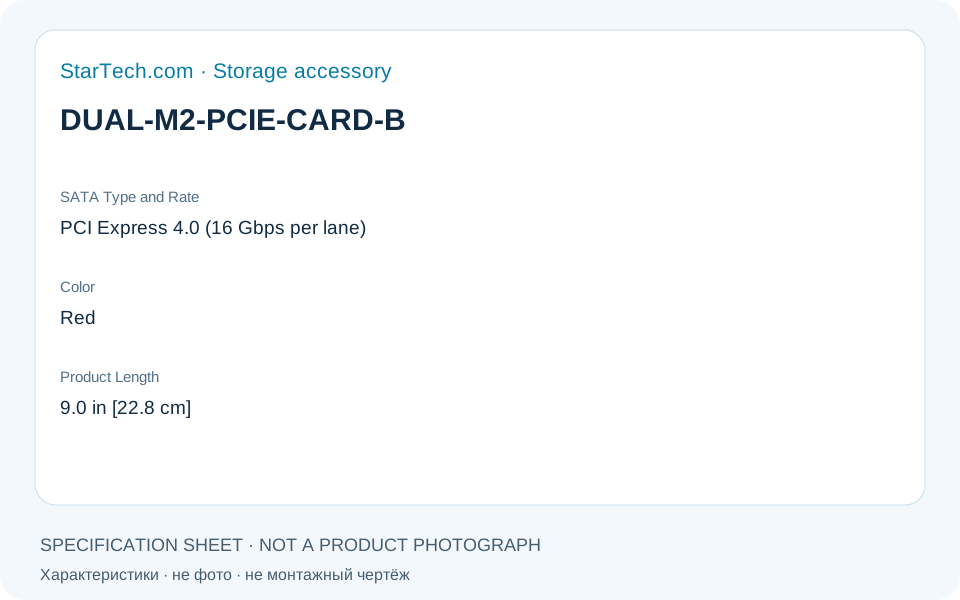 Specification schematic, not a product photograph or installation drawing.