- Model code
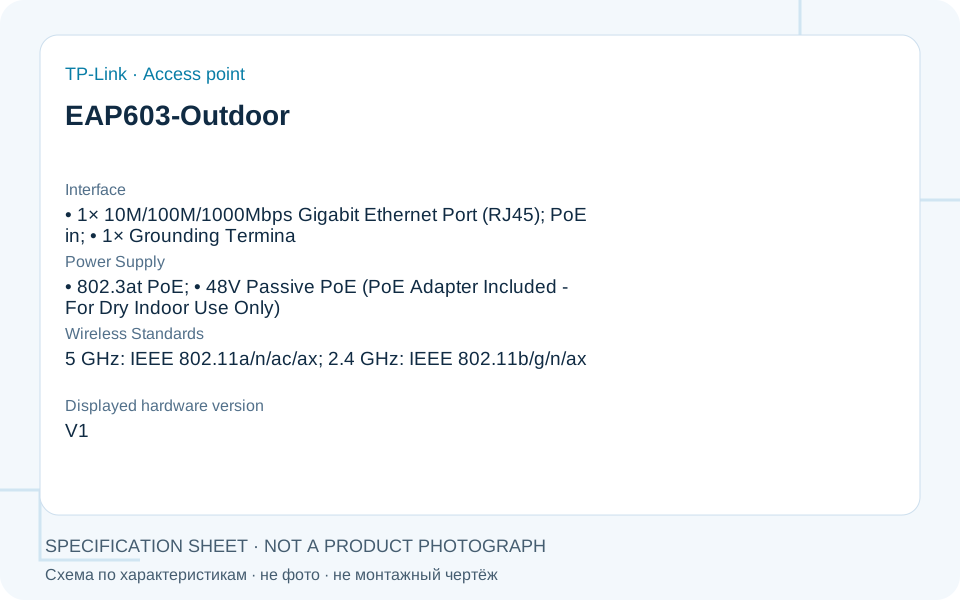
- EAP603-Outdoor
- Manufacturer designation
- AX1800 Indoor/Outdoor Wi-Fi 6 Access Point
- Source hardware version
- V1
- Interface
- • 1× 10M/100M/1000Mbps Gigabit Ethernet Port (RJ45); PoE in; • 1× Grounding Termina
- Button
- 1× Reset button: Press the button for longer than 5 seconds to make the device restore to factory settings.
- Power Supply
- • 802.3at PoE; • 48V Passive PoE (PoE Adapter Included - For Dry Indoor Use Only)
- Max. Power Consumption
- • 802.3at (PoE+): 15.8w, 2.4GHz radio 2×2, 5GHz radio 2×2, wired link rate can be up ; to 1 Gbps, etc.; • Idle mode: 4.8W(PoE)
- Dimensions ( W x D x H )
- • Main Unit: 230 × 207.5 × 69.7 mm (9.06 × 8.17 × 2.74 in.); • Shipping Unit: 324 × 104 × 245 mm (12.76 × 4.09 × 9.65 in.)
- Antenna
- Wi-Fi; • 2.4 GHz: 2 × 4 dBi (peak gain), external omnidirectional antennas; • 5 GHz: 2 × 5 dBi (peak gain), external omnidirectional antennas; *Note: The gains above are the single-antenna peak gains.; ; IoT; • Bluetooth: 1 × 4 dBi (peak gain), internal omnidirectional ; antennas
- Bluetooth
- Yes
- Weatherproof Enclosure
- IP66 for Wall Mount; IP65 for Pole Mount
- Mounting
- • Pole Mount (Kits included); • Wall Mount (Kits included)
- Omada App
- Yes
- Restore & Backup
- Yes
- Firmware update via Web
- Yes
- NTP
- Yes
- Centralized Management
- • Omada Hardware Controller; • Omada Software Controller; • Omada Central (Cloud-Based); • Omada App
- Cloud Access
- Yes. Require the use of an Omada controller.
- Email Alerts
- Yes
- LED ON/OFF Control
- Yes
- Management MAC Access Control
- Yes
- SNMP
- v1, v2c, v3
- SSH
- Yes
- Web-based Management
- Yes
- Coverage
- • 2.4 GHz: up to 2,150 ft (200 m) ; • 5 GHz: up to 3,200 ft (300 m)
- Wireless Standards
- 5 GHz: IEEE 802.11a/n/ac/ax; 2.4 GHz: IEEE 802.11b/g/n/ax
- Frequency
- • 5 GHz; • 2.4 GHz
- Signal Rate
- • 2.4 GHz: up to 573 Mbps ; • 5 GHz: up to 1201 Mbps; *Note: Country-Specific Restriction Apply
- Wireless Functions
- • Maximum number of BSSIDs: 16 (8 on each band); • Maximum number of associated STAs: 250+; • Guest Network; • ACS (Automatic Channel Selection); • Airtime Fairness; • Band Steering; • 802.11 Rate Control; • Rogue AP Detection; • URL Filtering; • WLAN Optimization; • Lock to AP; • SSID/Client Rate Limit; • Load Balance; • Seamless Roaming (802.11k/v/r, Non-Stick Roaming, Ping-Pong Roaming Suppression, AI Roaming) § ; • Multicast/Broadcast Management (Multicast-to-Unicast Conversion, ARP-to-Unicast Conversation, Multicast Filtering, Multicast/Broadcast Rate Limit); • QoS (Quality of Service)
- Wireless Security
- • ACL; • MAC Filter; • 802.1X Authentication; • MAC-Based Authentication; • WPA-Personal/Enterprise, WPA2-Personal/Enterprise, WPA3-Personal/Enterprise, Enhanced Open, and None; • Radius Accounting; • PPSK without Radius, PPSK with Radius (Generic Radius with bound MAC/EKMS/Generic Radius with unbound MAC); • Captive Portal: No Authentication, Simple Password, Hotspot (Voucher / Local User / SMS / RADIUS / Form Auth), RADIUS Server, External LDAP Server, External Portal Server, Pre-Authentication Access, and Authentication-Free Client; • EAP Types: EAP-TLS, EAP-TTLS, EAP-PEAP, EAP-CHAP, EAP-SIM, EAP-AKA, EAP-GTC, EAP-FAST, EAP-PEAP, EAP-MD5, EAP-MSCHAPv2, PEAPv0, PEAPv1
- Transmission Power
- Maximum transmit power:; CE (ERIP); • 2.4 GHz: 20 dBm ; • 5 GHz: 23 dBm in U-NII-1, 23 dBm in U-NII-2A, 29 dBm in U-NII-2C, ; FCC (Conducted Power); • 2.4 GHz: 25 dBm ; • 5 GHz: 27 dBm in U-NII-1, 24 dBm in U-NII-2A, 24 dBm in U-NII-2C, 27 dBm in U-NII-3; ; Minimum transmit power; CE (ERIP); • 2.4 GHz: 7 dBm ; • 5 GHz: 6 dBm in U-NII-1, 6 dBm in U-NII-2A, 6 dBm in U-NII-2C, 6 ; dBm in U-NII-3; FCC (Conducted Power); • 2.4 GHz: 4 dBm ; • 5 GHz: 4 dBm in U-NII-1, 4 dBm in U-NII-2A, 4 dBm in U-NII-2C, ; 4dBm in U-NII-3; ; Adjustable power increment: 1 dBm; ; *Note: MIMO combined power, excluding antenna gains. The actual ; transmit power depends on local laws and regulations
- Environment
- • Operating Temperature: -30 °C–70 °C (-22 °F–158 °F);; • Storage Temperature: -40 °C–70 °C (-40 °F–158 °F);; • Operating Humidity: 10%–90% non-condensing;; • Storage Humidity: 5%–90% non-condensing
- Selection limits
- Confirm exact hardware revision, regional model, adapter plug, firmware/controller support and required accessories before ordering. Published wireless PHY rates and maximum wired/VPN performance are conditional laboratory/standard limits, not guaranteed application throughput. Radio bands/channels, transmit limits, 6 GHz/AFC and cellular operator compatibility depend on country and local regulation. Antennas, SIM/eSIM plans, controller licensing and adapters are not universally included. PoE input powers this device; PoE output powers downstream equipment. Passive PoE is not automatically IEEE 802.3af/at/bt compatible; match voltage, polarity, pairs and available power budget.
- Manufacturer operating-mode notes
- † Maximum wireless signal rates are the physical rates derived from IEEE Standard 802.11 specifications. Actual wireless data throughput and wireless coverage are not guaranteed and will vary as a result of 1) environmental factors, including building materials, physical objects, and obstacles, 2) network conditions, including local interference, volume and density of traffic, product location, network complexity, and network overhead, and 3) client limitations, including rated performance, location, connection, quality, and client condition . § Omada Mesh, Seamless Roaming, Cloud Access, and Captive Portal require the use of Omada controllers. * T he advertised coverage is calculated based on laboratory testing. Actual coverage is not guaranteed and will vary as a result of the performance of the equipped antennas, client limitations, and environmental factors. ** The actual capacity depends on the wireless environment and client traffic and is generally less than the maximum number of client connections.
- Identifier scope
- Documented model code. Regional ordering suffix and bundle are not invented and are confirmed separately.

 Specification schematic, not a product photograph or installation drawing.
 Specification schematic, not a product photograph or installation drawing.
 Specification schematic, not a product photograph or installation drawing.
 Specification schematic, not a product photograph or installation drawing.